Automated Deployment
Every push deploys code, runs WP-CLI maintenance, clears caches, regenerates Elementor CSS, executes smoke tests, and generates a deployment report — with no manual intervention.
An AI-augmented engineering system for Meraki General Contracting that automates deployments, validates health after every release, generates documentation, and alerts stakeholders the moment something drifts.
Modern websites require more than simple deployments — they need intelligent automation, validation, monitoring, rollback strategy, and rapid incident response.
I designed and implemented an AI-assisted DevOps platform that automates deployments, validates website health after every release, generates deployment documentation, and immediately alerts stakeholders when issues are detected.
The result is a deployment pipeline that dramatically reduces release risk while providing continuous quality assurance and operational visibility — a working example of AI-augmented platform engineering and human-in-the-loop agentic workflows.
deploy · validate · report · recover
Every push deploys code, runs WP-CLI maintenance, clears caches, regenerates Elementor CSS, executes smoke tests, and generates a deployment report — with no manual intervention.
Critical customer journeys (Home, Services, Projects, Contact, Renovation Calculator, Consultation Booking) are validated after every release. Any unexpected HTTP status fails the deploy.
Failed deployments auto-generate a full incident bundle: failed URLs, status codes, workflow links, branch, commit, and deployment metadata — collapsing investigation time.
When smoke tests fail, stakeholders receive a structured incident report with failed URLs, workflow link, branch, commit, and next actions — no manual monitoring required.
Smart Plugin Manager validates updates on Staging before Production is allowed to install the same version — an additional quality gate before customers see change.
Automated visual diffs intelligently ignore non-deterministic elements like the CookieYes banner to prevent false positives and keep signal high.
Examples from the development workflow—including GitHub Actions, automated validation, deployment reporting, and AI-assisted incident management.
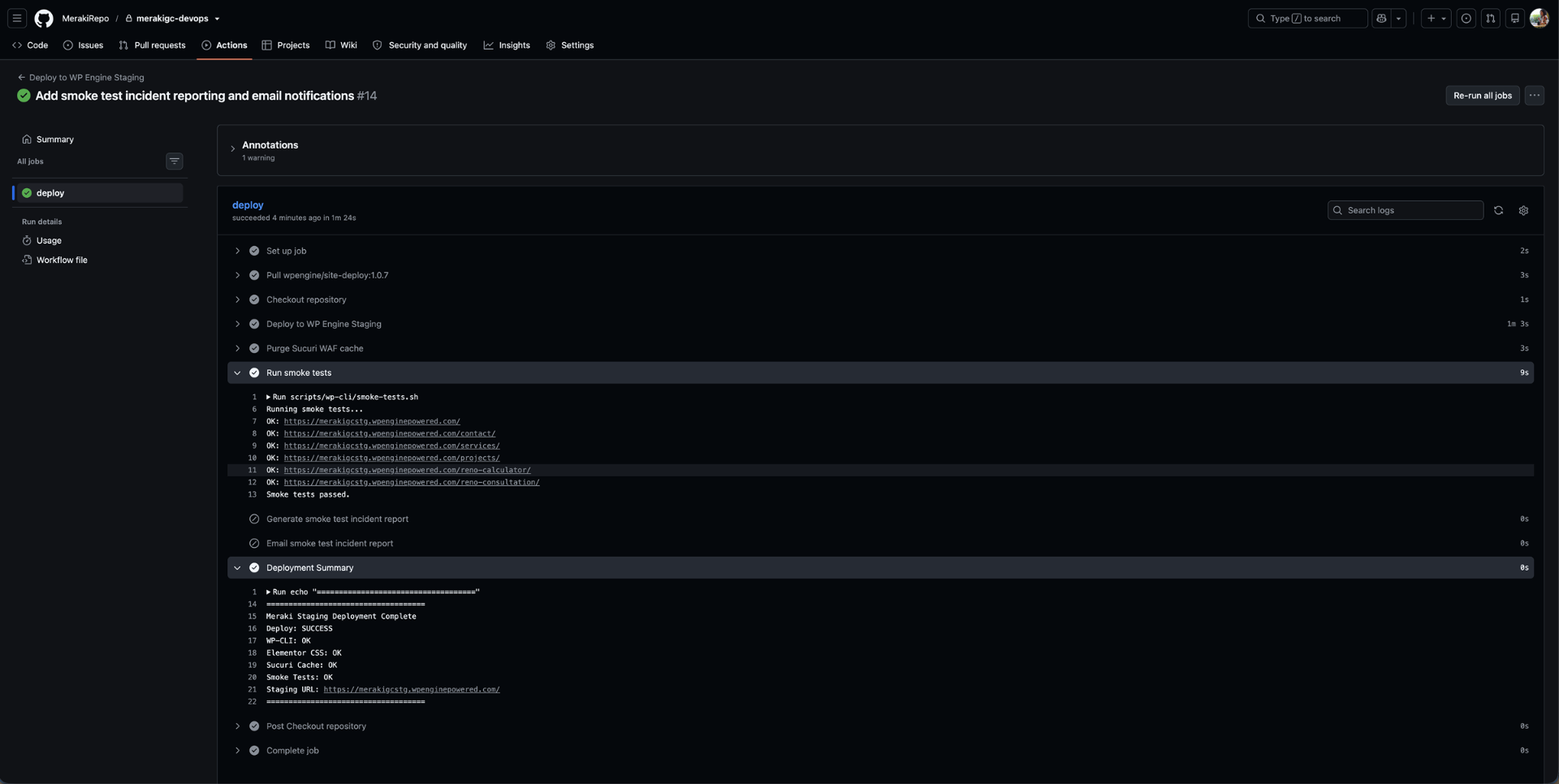
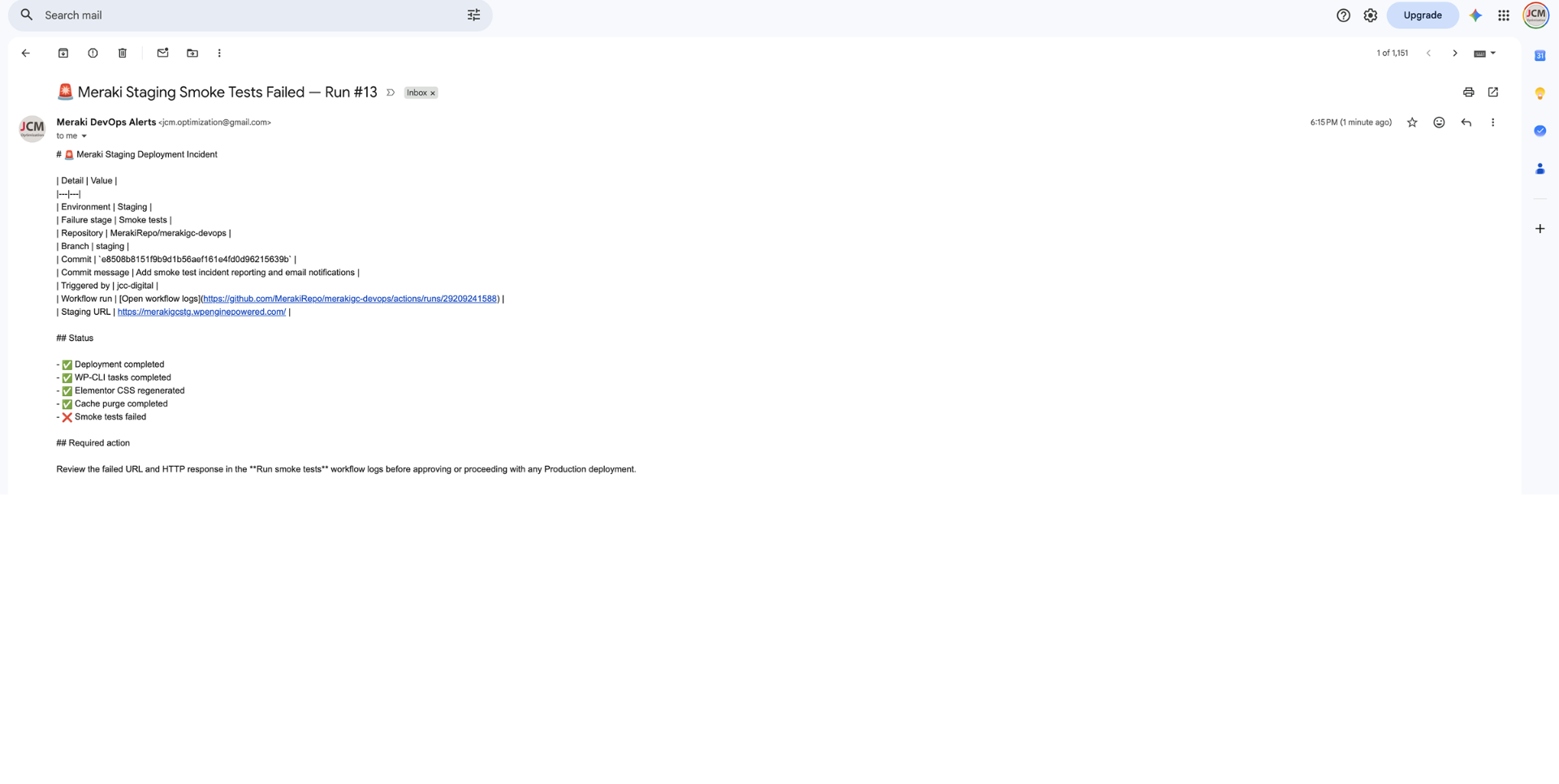
Built with an AI-assisted development workflow combining human expertise with modern coding assistants. AI accelerated workflow architecture, Bash scripting, GitHub Actions, YAML, debugging, deployment design, documentation, testing strategy, incident reporting, and workflow optimization. Architecture, validation, and implementation direction stayed under human control.
Automated release validation, deployment summaries, bad-deploy prevention, and incident report generation.
Intelligent post-deploy QA that validates critical customer journeys automatically.
Instant incident bundles with context, diagnostics, and recovery information the moment a failure is detected.
Deployment reports and incident summaries auto-generated per release — operational docs without manual effort.
AI accelerates workflow design, scripting, debugging, and DevOps implementation, while architecture, validation, and deployment decisions remain under human control.
AI participates across the delivery lifecycle — planning, implementation, validation, documentation, operations.
Every release validated before completion
Minutes, not customer reports
Routine deploy tasks automated
Multiple validation layers protect production
Every deployment leaves a documented record
Modern engineering is evolving beyond writing code. By combining DevOps, platform engineering, automation, and AI-assisted development, this system is more reliable, observable, and maintainable — and it maps directly to where enterprise software delivery is heading: AI Platform Engineering, DevOps, Platform Engineering, and Developer Experience.